| IN A NUTSHELL |
|
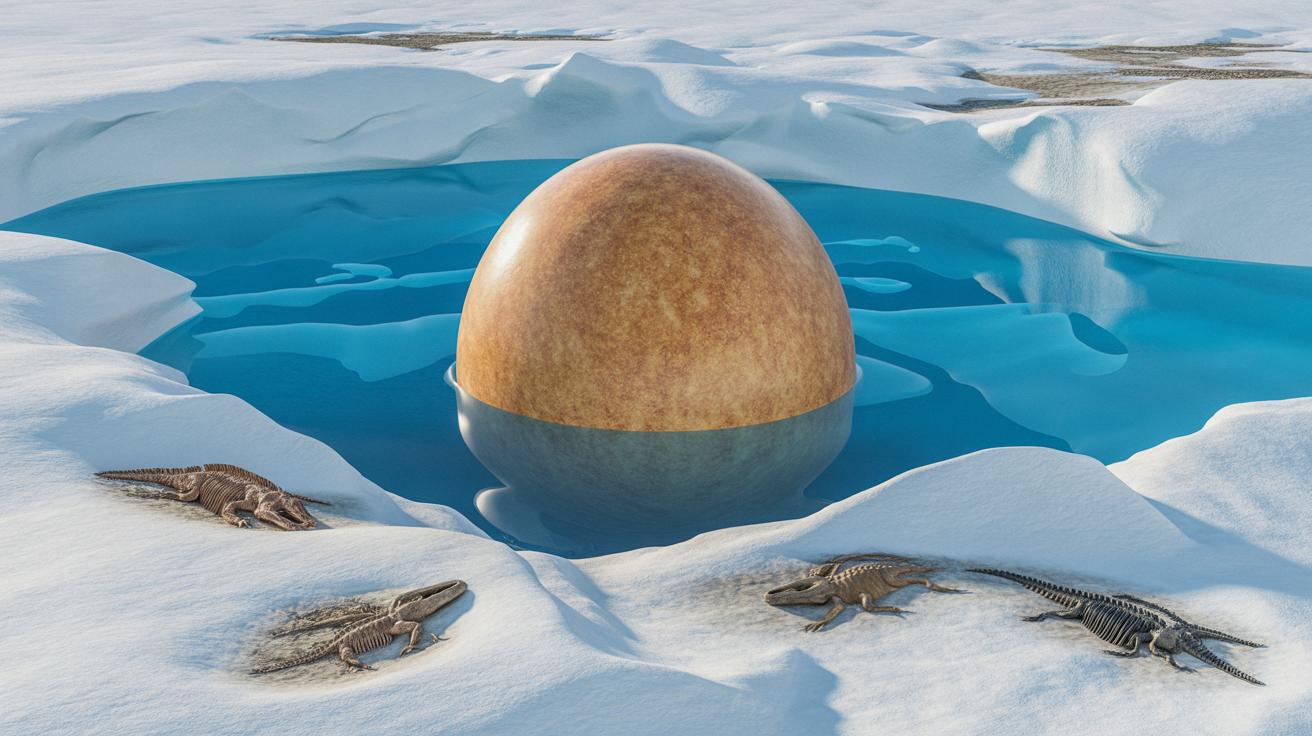
In the icy expanse of Antarctica, a remarkable discovery has captivated the scientific community, challenging long-held beliefs about prehistoric marine life. A fossilized egg, buried for over 60 million years, has emerged from the snow and ice, offering new insights into the reproductive habits of ancient marine reptiles. This unprecedented find, known as Antarcticoolithus bradyi, is not only reshaping our understanding of the Cretaceous period but also sparking a wave of excitement and inquiry among paleontologists worldwide.
A Fossil with No Parallel
The Antarcticoolithus bradyi egg is an anomaly in the world of paleontology. Unlike typical dinosaur eggs, this egg lacks the porous texture and hard shell that are characteristic of its kin. Instead, its thin, papery surface and partially collapsed shape suggest a different evolutionary path. According to Julia Clarke from the University of Texas at Austin, the egg’s exceptional size and structure are unlike anything seen before, making it a truly unique discovery.
Lucas Legendre, a postdoctoral researcher at UT Austin, leads the study on this remarkable find. He notes that the egg bears more resemblance to those of modern lizards and snakes than dinosaurs. This suggests a reproductive strategy previously unconsidered for ancient marine reptiles. The egg’s morphology supports the theory that it was laid in water and hatched almost immediately, challenging the assumption that marine reptiles of the Cretaceous period gave live birth.
Signs Point to a Giant Mosasaur
While the egg itself contained no embryo, its proximity to the remains of Kaikaifilu hervei, a massive species of mosasaur, provides strong clues about its origins. Found just 200 meters from the mosasaur remains, the egg’s dimensions align with a mother of at least 23 feet in length, excluding the tail. This size matches known estimates for K. hervei, suggesting a direct connection.
 Continue exploring with this post : Love Horoscope For July 19, 2025 — Unexpected Revelations Shake Your World
Further supporting this hypothesis is the discovery of fossilized remains of juvenile mosasaurs and plesiosaurs in the vicinity. These findings indicate that the area may have served as a birthing or nursery site. Clarke and her colleagues hypothesize that the reproductive strategy of these ancient reptiles might have been similar to modern sea snakes, which lay thin-shelled eggs in the ocean that hatch shortly after being laid.
Revealing a Broader Evolutionary Shift
The discovery of the Antarcticoolithus bradyi egg has broader implications for our understanding of reptile evolution. The delicate, soft-shelled nature of the egg suggests that such eggs were once more common among reptiles and early dinosaurs than previously thought. Darla Zelenitsky, a paleobiologist specializing in fossilized eggs, finds the discovery particularly exciting as it challenges the long-standing belief that dinosaur eggs were primarily hard-shelled.
Recent finds of soft-shelled eggs from dinosaurs like Protoceratops and Mussaurus support this new understanding. These discoveries suggest that the fossil record may have underestimated the prevalence of soft-shelled eggs due to their fragile nature, which makes them less likely to fossilize. Mark Norell from the American Museum of Natural History asserts that these findings indicate that the ancestral dinosaur egg may have been soft-shelled, prompting a reevaluation of previous assumptions.
Questions About Laying Behavior Remain
Despite the advances in understanding brought by this discovery, questions about the egg-laying behavior of ancient marine reptiles remain. One hypothesis suggests that mosasaurs laid their eggs directly into the ocean, akin to some modern marine reptiles. Another theory posits that these reptiles came ashore to lay their eggs, with hatchlings making their way to the sea like modern sea turtles. However, due to the mother’s size, the former seems more plausible, although not definitively so.
Diagrams from the study by Legendre and colleagues illustrate the egg’s anatomy and its relative size to a human, underscoring the significance of this find. The fact that such a well-preserved fossil was uncovered in Antarctica suggests that the continent may harbor more hidden treasures awaiting discovery. As researchers continue to explore, the discovery of Antarcticoolithus bradyi invites further questions about the evolutionary complexities of ancient reptile reproduction.
The discovery of the Antarcticoolithus bradyi egg has opened a new chapter in paleontology, challenging established narratives about prehistoric life. As scientists delve deeper into the mysteries of this find, it raises intriguing questions about the reproductive strategies of ancient marine reptiles. What other secrets lie buried beneath the Antarctic ice, waiting to reshape our understanding of the past?
 Continue exploring with this post : 3 Zodiac Signs Experience Unparalleled Growth & Prosperity On July 19, 2025
Did you like it?4.4/5 (23)